
 Along with regular coverage in DIY Week and Builders Merchant News, we have been putting forward IronmongeryDirect to the broader business press as ‘one to watch’ with the exciting growth it has achieved, and how it is making this happen. This has included arranging interviews and compiling Q&As which has resulted in coverage in Real Business magazine, Catalogue E-business and Marketing Week as well as issuing business results and updates, and newsjacking.
Friday, 22 July 2011
Raisng the profile of IronmongeryDirect
Along with regular coverage in DIY Week and Builders Merchant News, we have been putting forward IronmongeryDirect to the broader business press as ‘one to watch’ with the exciting growth it has achieved, and how it is making this happen. This has included arranging interviews and compiling Q&As which has resulted in coverage in Real Business magazine, Catalogue E-business and Marketing Week as well as issuing business results and updates, and newsjacking.


Thursday, 21 July 2011
Taranta, An Office To Create
 When you think of an office, you don't normally realise how different it would look from floor level.
The fascination in the Red Town Office (Shanghai, China) of architecture firm Taranta Creations lies exactly in this difference of perspective.
The building originally hosted a metal factory, and the distance between the structure and ceiling was far too small to accommodate a modern office layout of floor and tables.
 Hence the beautiful design, including four working stations placed in the space between the steel profiles. This transforms the floor into a continuous desk, inviting the designers to use the open space for sketching, brainstorming, planning, drawing, modelling and generally creating their new projects. Productive and beautifully informal.
Read more on ArchDaily.
Images © Shen Qiang / Shen Photo

Wednesday, 20 July 2011
Porcelains & Energy Plants
 This building definitely has a strong Dutch taste, in a beautiful blend of old and new.
It is a new Combined Cycle Energy plant (CHP) in Roombeek, Holland. Its core function to provide light and heat to the city - hence its name, Stadshaard (Dutch for "city hearth").
 To celebrate this building's identity, architecture design firm Cie collaborated with artist Hugo Kaagman to tile it in an iconic Delftware style.
It is a touch of tradition, which makes Stadshaard the largest delftware artwork in the Netherlands.
Following their original use, the tiles depict scenes (and you can see a sample in the images) that communicate the function of the building.
The result is charming. Read more.

Monday, 18 July 2011
Murcia: Lifetime Tickets and Car Strip Tease

Attempting to reduce congestions, Murcia is offering a lifetime pass to its tram transportation in exchange for its citizens' cars. Any working car can qualify, old or new, it is sufficient to register and trade in the vehicle.
Far beyond many other cities' attempts to promote bikes or car shares, this initiative has an interactive side too - and it is ready to go viral.
The exchanged cars are used as art installations, creating a sort of car strip tease by disassembling them slowly.
For every comment on the project's Facebook or Twitter accounts, a part of each car is removed and broadcasted on webcam. The installations themselves represent the hassle of, say, finding parking and are placed even on top of each other. Until they "disappear" that is.
A great initiative, read more on InHabitat.

Tuesday, 12 July 2011
A (Floating) Cocoon For Your Break
 Amniotik somehow bears the allure of deep and complete intimacy and somehow reminds us of the Matrix movies.
In fact, this electromagnetic floating capsule is designed as a cosy and maternal recovery for moments of stress. You will experience weightlessness while choosing the treatment to be pampered with on an interactive touch screen.
Now, the fact that the cocoon should be filled with liquid (floating experience) and that an oxygen mask is involved does arouse every little bit of claustrophobia in the best of us.
But, we would give it a try. Would you?
Concept by Noela Leis, this is definitely a piece of design we will all have an opinion on.
Read more on DesignBuzz.

Monday, 11 July 2011
Origami Tower, the Heights Of Taiwan
 Building and hosting the world's tallest building is an interesting competition, and Taiwan is bound to have a place in it. Or rather, two.
Little after Taipei 101 was outrun by Burj Khalifa, here is the next exciting project. This 300m tall tower is yet to be build but will incorporate designs from the diamond industry and vaguely remind of the Eiffel Tower in Paris. Another source of inspiration was origami, the ancient art of folding paper. A further mention to the star/sun reference in the Taiwanese flag and we get the picture: a sharp and slender tower, which was effectively rendered in a thunderstorm.
Design is by OODA and OOIIO.
Read more on DesignBuzz.

An iPhone With Professional Lenses
 We have heard this a thousand times. What is the use of having a 5 megapixel sensor on your camera, if the lenses are those of an old disposable camera?
Photojojo could have possibly overdone it with their latest iPhone SLR Mount. But the support is compatible with any Nikon or Canon EOS lenses, turning your smartphone into a professional camera. After all, it is true that smartphones have photographic ambitions, with all the photo retouching and special effects applications.
You might be stared at while you are using this mount, but it is a very cool concept.
Read more on Cool Hunting.

H&M for Wateraid
 Now this is a cool initiative by H&M. A two day sale in a temporary container on the beaches of The Hague's popular Scheveningen resort. The profits will help raise this year's contribution to WaterAid, an international NGO that provides access to safe water, hygiene and sanitation.
The Swedish brand has marked the ninth annual collaboration with WaterAid featuring the "Beachwear in Shades of Blue" right on the shore.
Each year H&M donates 10% of the proceeds connected to a particular bikini line, this time they have exceeded all expectations.
Read more on InHabitat.

Wednesday, 6 July 2011
Tubo Hotel, Mexico
 Along the lines of re-conceiving existing construction materials, here is Tubo Hotel.
Architects T3arc faced the challenge of building a fast and affordable hotel to offer lodging to the tourists of Tepoztlan, Mexico.
They used concrete tubes as prefabricated units for the rooms, creating an amusing effect with groups of three rooms. The whole complex took only 3 months to build and we find it just... fun!
Check out more pictures on ArchDaily.
Image © Luis Gordoa

Mom, I Want To Become A Chocolate Printer
 3D printing is a fascinating technology - you press CTRL+P on your keyboard and you obtain, layer by layer, a three-dimensional object. Of course the process is more complicated and this probably is the fascination of who does not have to work with it every day.
Yet, what is universally cool is the idea of using chocolate as a mould.
Being inexpensive and easily malleable, it also yields no waste (the excess can be molten down again or eaten), making chocolate a perfect raw material.
This is happening at the University of Exeter, where researchers of EPSRC (Engineering and Physical Sciences Research Council) are developing their own chocolate revolution. The idea is that of providing to online customers the possibility of customising their chocolate orders by uploading their own designs. It is a whole new chocolate experience.
Read more on InHabitat.

Tuesday, 5 July 2011
An Island to Light Up Copenhagen
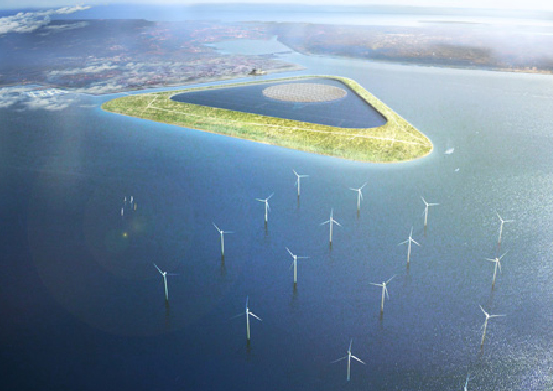 Think big and you'll generate power for a whole country. Starting from its capital, like Copenhagen.
This "little" green jewel designed by Gottlieb Paludan encompasses a sustainable energy combination (wind power, solar power and pumped hydro power), which could become Copenhagen's alternative energy centre.
When the wind speeds decrease, seawater is pumped in the inner island lagoon, turning turbines that generate power.
Green Power Island is also bound to become the biggest solar plant in Scandinavia. Four sister projects have been proposed for Bahrain, India, China and Florida.
Read more on InHabitat.

Amazing 40 Feet High Book Case
 As huge fans of walls filled with books, could not help but gaze in awe to this family bookshelf that Sallie Trout built in the centre of her own home.
Going up for 40 feet, you can reach some shelves from one floor, some from another, but all of them using a remote-controlled chain hoist. Sitting on a bosun's chair (normally a stable climbing device), you can wander up and down the triangle shaped spiral stairs looking for the book you need.
Have a look at more images, we just loved it!

Stamp Your Smiley With Kaoiro
 We often transfer our habits from the "real" world to our virtual domains: it is the case of "winks", "pokes" and so on. Sometimes, the process goes the other way round as with Kaoiro, the smiley stamp.
Based on the same principles of the - we're tempted to say retro - "date stamps", Kaorio's dials can produce over 2,000 kaomoji (Japanese for emoticons). These go far beyond the popular colon-hyphen-parentheses :-), pushing you to create new options to give voice to your mood. It's a fun way of making a point, be it to say "I'm not sure about this artwork" or "This logo is amazing!" You're invited to experiment.
Read more or buy Kaorio on the Japan Trend Shop ^__^

Monday, 4 July 2011
CAT, your aquatic cab.
 If you used the tube to go to work this morning, you may have wished for a bit more intimacy, added comfort and possibly a better view. Then when you get to your desk and bump into CAT (City Aquatic Transportation) once again, you can't stop from imagining a whole different journey.
Aimed at exploiting cities' waterways to relieve the urban congestions, these four-passenger crafts designed by Cal Craven propose a thrilling alternative. Their futuristic design is completed with integrated Wi-Fi, autopilot and 360 degree rotating seats. The small vehicles are conceived to be booked online at specific docking stations.
Interestingly enough, the possible uses go beyond "simple" transportation, including business meetings (with an incredible scenery), tourism (with manual pilot) and quite an alternative lunch location. We would definitely book one, or more, today.
Read more, images Curve Creative.

Wednesday, 29 June 2011
AMMI: the self-driven delivery cart
 When your virtual shopping cart gets actually physical, you get AMMI: the Automated Mobile Marketing Intelligence.
Shaped like a shopping cart, this useful little robot is capable of bringing your groceries home without any guidance. Using a driverless street recognition system, you will shop online, open the door for AMMI and then just wait for it come back from the supermarket. It even has an incorporated cooling system. Can't wait to try it! It would be interesting to see dozens of these wandering around the streets.
Designed by Alvin Chan. Check out some more images.

A Printer To Remove Ink
 Zap, slip a printed paper in this printer and you'll get a clean white one in exchange. In the perspective of re-using paper and office supply, here's an interesting new gadget by designer Kim Su Yeon.
The Ink Removal Printer applies a similar concept of a dermatologist laser-burning dark spots from your skin to paper. Apparently it works specifically with non-ink based printing, as your office's laser printer.
We can ask ourselves whether this system is more energy efficient than traditional paper recycling. But, hey... the idea is great!
Read more on Yanko Design.

Changing the Face Competition: Rossiya's Flourish
 This is a spectacular entry for the Changing the Face Competition 2011, a yearly event promoted by DuPont that generates a brainstorm around different cities' "emotional" buildings.
Gijo Paul George and Hend Almatrouk proposed a concept that combines two faces of the Pushkinky (formerly Rossiya) Cinema in Moscow. The contrast between past and present is strong and represented with rigid geometrical shapes for the disciplined and puritan communist rule and with alluring and flamboyant lines for today's consumerism and hedonism.
It is an architectural reflection on how the city, and by extension the Russian film production, has evolved through time. We were dazzled by the design, check out some more images.

Aqua-skip Your Way Across the Thames

This light watercraft (it weighs a manageable 26 pounds) can reach 17 mph if you are in a hopping spree. A fiberglass spring transforms the rider's hopping motion into a push forward, propelling this light aircraft-grade aluminium vehicle in the desired direction. As the hydrofoil frame has very little drag, you will easily reach interesting speeds.
As a small note, this water sport has already gained quite a large following in Germany. Shall we import it in the UK?
Read more.
Image from designyoutrust.com.

Sunday, 26 June 2011
How will the new EU Directive on Internet Privacy affect your web site?

From 25 May, European law dictates that "explicit consent" must be gathered from web users who are being tracked via text files called "cookies".
The directive demands that users be fully informed about the information being stored in cookies and told why they see particular adverts. This will impact upon, for example, the automatic registration of visitors to sites or tracking to provide relevant marketing to visitors, both of which use either Session or Persistent Cookies to recognise visitors and simplify their experience. The Directive does, however, specifically exclude use of cookies that track items that are placed in shopping carts.
However, all is not lost. The Directive says that it may be possible for a user's consent to be provided by their use of appropriate browser settings.
“…Where it is technically possible and effective, in accordance with the relevant provisions of Directive 95/46/EC, the user’s consent to processing may be expressed by using the appropriate settings of a browser or other application. The enforcement of these requirements should be made more effective by way of enhanced powers granted to the relevant national authorities.”
Directive page L 337/20, paragraph 66
This may appear good news, however not everyone will visit a web site through a browser that allows these settings to be adapted. For example, browsing using a mobile phone or older versions of browsers.
“At present, most browser settings are not sophisticated enough to allow you to assume that the user has given their consent to allow your website to set a cookie. Also, not everyone who visits your site will do so using a browser. They may, for example, have used an application on their mobile device. So, for now we are advising organisations which use cookies or other means of storing information on a user’s equipment that they have to gain consent some other way.”
UK ICO
In an attempt to help businesses in the UK to prepare for and comply with the EU Directive the Information Commissioner’s Office (ICO) has issued guidance, aligning UK law with the EU Directive in the belief that a browser setting signifies consent.
“(3A) For the purposes of paragraph (2), consent may be signified by a subscriber who amends or sets controls on the internet browser which the subscriber uses or by using another application or programme to signify consent.”
In addition, the ICO explains that those cookies that are “strictly necessary” to providing a service are exempt from the new rules. The ICO also adds;
“At present, most browser settings are not sophisticated enough to allow you to assume that the user has given their consent to allow your website to set a cookie. Also, not everyone who visits your site will do so using a browser. They may, for example, have used an application on their mobile device. So, for now we are advising organisations which use cookies or other means of storing information on a user’s equipment that they have to gain consent some other way.”
The BBC has recently reported; “The government has formed a working group with browser manufacturers to see if a browser-based solution to the issue can be found. Microsoft’s IE9 and the latest version of Mozilla’s Firefox already offer a setting to protect users from services which collect and harvest browser data and Google is working at integrating so-called ‘Do Not Track’ technologies into their Chrome browser. As part of its work to comply with the directive, the IAB has created a site that explains how behavioural advertising works and lets people opt out of it.”
So what does this mean for businesses that run web sites; well, if you use cookies to track your visitors you cannot assume that they have expressly agreed to the use of cookies through their browser settings.
In the short term additional 'opt ins' or information communicating the use of cookies may be required upon registration to a web site where the user agrees to the specific use of cookies.
In the medium to long-term it is hoped that a person's browser settings will provide the consent required to overcome this additional opt in by web site users and maintain the benefits provided to the user by the use of cookies.
The law is far from clear at present and The Think Tank is unable to offer legal advice however this is a topic that should be on the radar of web site owners and if you are worried about your web site and the use of cookies we advise that you speak with your legal representative to clarify your personal circumstances.
Disclaimer: The Think Tank is not a legal adviser and is only commenting upon this subject. We do not accept any liability for any actions taken upon the information contained in this article.

Wednesday, 22 June 2011
Pantone Rooms For Your Stay At Wanderlust Hotel

 If working with colours represents a big part of your professional life (and more specifically Pantone colours), the Wanderlust Hotel in Singapore is your next destination.
You will find Mono (chromatic) rooms, inspired by origami and pop-art; Pantone rooms with obvious colour references and Whimsical rooms, the themed suites.
The concept is quite experimental and the hotel is designed with contributions from four different agencies.
Four different themes colour the 29 rooms, from the "Industrial Glam" atmosphere of the Lobby to the "Eccentricity" rainbow corridors with bright neon lights. A pop-art level and the friendly monsters of the third floor's "Creature Comforts" can only seal the deal.
The images are courtesy of Wanderlust Hotel, read more.

Subscribe to:
Posts (Atom)

 Posts

